
 Join Talent Network
 Saved Jobs
 Sign In

Inside software engineering at Capital One
The path to an engineering career at Capital One is rarely a straight line. Our teams are made up of lifelong tech enthusiasts, startup founders, former scientists and career-changers who all made the leap into the tech world to make a difference. Whether they discovered their passion as a kid or stumbled upon it later in life, these engineers thrive by staying hands-on with the craft.
What connects them is a shared purpose: Capital One software engineers have found a place where they can take direct ownership of high-impact products to solve real problems for customers.
We talked to engineering teams across Richmond, Boston, Plano and McLean to learn about their day-to-day experiences and how they turn challenges into opportunities.
What’s a real-world problem your code is solving right now?
Michael, Richmond: The best part is touching custom-built systems designed to improve banking. Because we have the opportunity to build our own infrastructure, we can deeply understand how everything works. We’re constantly pushing the envelope, like when we eliminated overdraft fees to support customers and eliminate a pain point for them.
Wesley, Boston: My work helps small businesses pay invoices with credit cards. Before we launched, owners often had to send expensive wire transfers, but we were able to reduce transaction costs. I go to work knowing my code is helping someone’s bottom line.
Hailey, McLean: I’m working on a platform that manages data at a massive scale. It was originally built for one specific credit card team, but we’re now making it available for every single team at Capital One. It’s a big deal because it enables the maintainability and scalability needed to ship better products to our customers much faster.

How are you using emerging tech to change the way we deliver solutions?
Alex, Boston: My team used gen AI to automate how we read and organize complicated technical documents. This was a task that could originally take an engineer weeks to solve manually. Now, we’re saving our engineers hours of time and enabling them to be much more responsive.
Emily, Boston: I worked on a Slackbot that helps our team manage industry requirements and mandatory reporting. My team integrated natural language processing so associates could ask simple questions instead of memorizing rigid command lines. Knowing that a project I built as an intern is still used today is incredibly rewarding.
What’s the rhythm of your typical day?
Trevor, McLean: Mornings usually start with deep-focus coding and building new tools. After a team standup around lunch, afternoons shift toward collaboration and meeting with other people to solve problems together. It’s during those later hours that I branch out to discuss new features or integrations with other teams across the company.
Wesley: My team starts with a quick, 10-to-15-minute daily standup to discuss progress and any blockers. From there, I dive into my tasks and collaborate with teammates to get the information I need to keep moving. Once I’ve built a solution, I share it with the team for a peer review to ensure the code is high-quality and secure. After the team signs off, we integrate the work and release it so it can start helping our customers. The best part of the day is the collaborative time spent making sure we’ve found the best way to solve a problem.
Michael: Having true ownership over my projects makes me much more invested in the work. In building our own infrastructure, we have the autonomy to decide how to best focus our days to understand our systems and find new ways to improve customer experiences.

What led you to a career in software engineering?
Marina, McLean: I studied biology and chemistry on a pre-med track, but I always had a dream of working in tech. When I realized I didn't want to spend years in medical school, I decided it was time to pivot. I joined an immersive program at Capital One designed to help those from non-traditional backgrounds transition into tech, and I haven’t looked back.
Devo, McLean: My passion for data and engineering comes from my very first job out of grad school at a startup. My role was to investigate why merchants weren’t seeing the ads they bought on specific pages. Being able to build a narrative for something so elusive gave me an appreciation for what it means to have good data when the business’s money was on the line. That experience stuck with me, and now I apply that same data-backed mindset to making a difference at Capital One.
How do you find the flexibility to grow in a way that works for your life and goals?
Colten, Plano: Our data stack runs on the cloud, and though I arrived without hands-on AWS experience, I was encouraged to learn on the job and earn my AWS certification. It turned out to be a real positive. I gained a skill that’s valuable anywhere, and I use it every day here.
Devo: Capital One invests in you as a whole person. I’ve taken leadership courses that changed how I communicate and gone to conferences that sharpened my technical edge. It’s a place where you aren’t just writing code, you’re building a career with a massive support system behind you.
Marina: Capital One has offered me so many ways to grow. I have access to mentors who encourage me to pursue professional certifications and access to learning platforms to further my technical skills. Now that I’ve benefited from that investment, I try to give back by supporting new associates as they transition into their engineering careers.
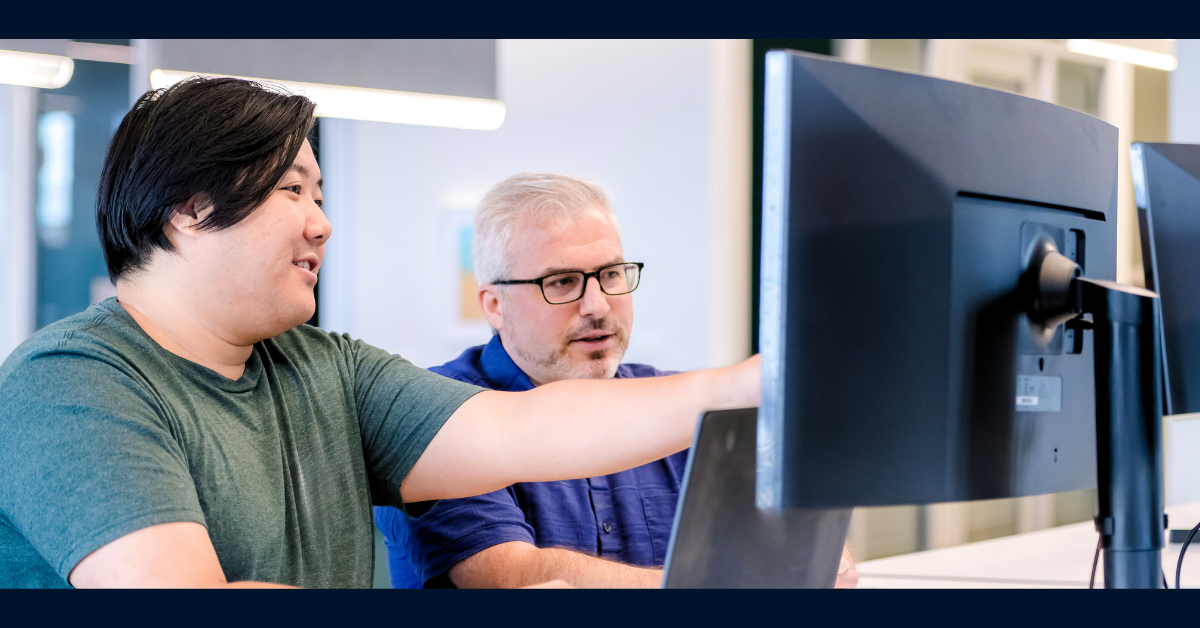
What’s the secret to making an impact as a Capital One engineer from day one?
Emily: To be successful here, you have to focus on both people and tech skills. It’s a culture around building consensus. You’ll almost never solve a problem alone. It takes communication skills to influence a project's direction while remaining open to other ideas and feedback that make the products stronger.
Devo: Be intellectually curious, ask a lot of questions and don’t make assumptions. Also understand that the simplest answer is often the right one. Simplicity in technical designs is beautiful because there are fewer things that can go wrong and fewer areas to investigate when they do.
Marina: Whether you’re joining with engineering experience or you’re coming in from a non-traditional background, it’s so important to be authentically you. Capital One is looking to give you the tools you need so you can thrive here. Be excited to learn and be enthusiastic about the potential you have to grow once you join.
Capital One engineers have the space to build cutting-edge products and the support to grow their expertise. See how you can make an impact on our team.
Related content



Copyright © 2026
Opinions are those of the individual author. Statements are deemed accurate at the time of posting. Unless otherwise noted, Capital One is not affiliated with, or endorsed by, any company mentioned. All trademarks and intellectual property used or displayed are the property of their respective owners.